Monday, December 4, 2023
Why Do Animals Suffer If We Are The Ones That Sinned? A Brief Note.
As to animal suffering. If we consider Origenian theology we can reconcile this by suggesting that suffering is related to what in Isaiah 66:1 and Psalm 110 refer to as the footstool. The earth is God's footstool. In short, the footstool is this physical, three-dimensional space of existence that divine beings created by God were meant to 'walk' on. However, due to our 'missteps' 'sin' we fell, and thus crawl through the footstool as one crawls on the floor when fallen rather than walking on it. It could be the case that the suffering of animals is the result of a divine being, being partially instantiated in the footstool, just as one gets stuck in mud when they fall, until God, through Christ, picks them up and stands them upright. Therefore, it could be the case that animals are partially instantiated divine beings whose level of consciousness is based on the level at which they fell into the footstool, and the pain they feel is the inappropriate relationship they have with the world and they 'await' being lifted back up. The pain is their own fault, which due to the fall they can't fully recollect. But in spite of this, all will be made new as per Revelations 21:5.
Now as to Jesus placing the demons in the pig. I don't think Jesus intended the pigs to jump off of the cliff. However, the demons themselves made the pigs fall. But it is possible to find deeper questions in this example through our own eating of other animals. I would argue that oftentimes in order to maintain a footstool existence, the material of the footstool must be maintained through uncovering that material from other souls through the process of killing for life. It isn't God sanctioned, but rather a practical strategy for footstool survival.
And so, animals' 'sin' is their sharing in the same act of 'falling' onto the footstool (just as one falls who is not watching where they are going and trips) as us. The variation of species is in their level of fallenness (which dictates how conscious they are of their footstool surroundings) and the variety of features reflects the degree to which they are 'covered in' footstool material. If just a knee, possibly an insect. If an entire torso, perhaps a reptile. If most of the divine being except the face is up out of the footstool, maybe a mammal. This is just an hypothesis. But it solves the hypothetical problem of animal suffering.
Are Demons Just Our Darker Selves?
Are demons just extensions of the self? For one, I would say that the idea that angels and demons are merely projections or revealed aspects of the one's own self before they are brought to gnosis is a speculation that is less tenable than the view they are separate entities. For if they are merely parts of the self that only appear to be separate due to our ignorance, then how can we distinguish anything intuitively prior to our rational abilities kick in? For reasoning is a continuum, not an either/or (except in the case of intuited necessary truths), and there is no point we 'know' the difference between ourselves and those phenomena outside of it unless we regard certain intuitive categories (that's not me that is something else) as immediate. Likewise, if reasoning reveals through laborious thinking differences then how can it establish anything outside of solipsism. Indeed, even solipsism cannot support the position that anything exists or 'is' given the epistemic leap from knowledge to ontological statements such as x is the case.
As well, I would also say that Crowley's statement, though I think one of the most well thought out and thorough definitions, suggests that ALL actions initiated by the will are magick. Of course, he invented the term and therefore can do whatever he 'wills' with it, no pun intended. But I would say that magick, however it is spelled, requires a paranormal, or non-naturalistic, origin; namely that one wills, or causes, something to happen without physically touching it with one's body nor without appealing to another's will through conversation. I would say that magick is tapping into a more primal origin of reality and causing changes in this realm and allowing it to precipitate or emanate downward. I think prayer and meditation for the entirety of human existence has done this.
As to Jung's views, I think the jury is still out on whether archetypes are separate phenomena, themes, entities from the self or not. It isn't clear, and I may be wrong here since it has been a long time since I actually read Jung, that he had a firm view on them being actual extensions of the self. If he did, I would disagree. However, I am convinced that they are separate given my above view on intuited categories and their logical inconsistency with reasoning out previously unconscious content.
To caveat this statement, we are held in existence by ONE being. But our distinction is real and our distinction can continue (and I would argue will since if ONE being is the source of goodness and it is good we exist then there would be no reason to dissolve our being a separate entity or thing held by this ONE being).
It was Parmenides, the Greek philosopher, that held to the view that the many is an illusion. Many subsequently followers of this school, such as Zeno, demonstrated the problem of the many with Zeno's paradox which logically showed that motion is impossible. However, the only flaw in his logic was to assume that human logic is sufficient to explain ALL things without phenomenal disclosure (see Heidegger's phenomenology) or religious or spiritual revelation. For if Zeno was right then it would be impossible for there to be phenomenal traits that exhibit multiplicity. Therefore, when we recognize that a phenomenon is separate from us, in intentions, agency, and expression, it really is.
Will Everyone Be Saved Part 1
in homiletics we have expository and topical preaching. And yet, we find that homiletics, which comes from the words homily, means one from the many, discourse, a unified whole of people…it reflects a form of revelation as Barth points out in his dogmatics…but this sort of revelation isn’t universal (for all churches in all times for all people), but provincial (for certain people, in a certain time, practical, etc.) So we have universal and provincial revelation…
As to universalism, as per Robin Parry and Talbot, we see a distinction between an existential eschatology and an actual one. The former is something like ‘if you continue doing X you will be in Hell…” It is the natural consequence of staying in X. But this says nothing to whether it will ALWAYS be the case. They further argue for rhetoric. For instance, the rhetoric of the OT concerning the destruction of Sodom or even Jerusalem sounds eternal but in actuality is only for a time and is rebuilt. So, this could be what hell language is like. We wouldn’t tell ppl that if you continue to sin you will go to hell BUT eventually be saved. You withhold the last part of the eschatology for existential reasons, even Origen preached hell fire though he believed in universal salvation.
Also consider the trilemma of Talbot…1. That the Bible teaches God wishes all to be saved. 2. The Bible teaches that God CAN save all 3. The Bible teaches that at least some will be in conscious eternal torment in hell for sin.
Should We Accept Naturalism As A Default Position On Reality?
I had been having a discussion debate with an atheist online and they claimed that naturalism, ad nauseum, was the default position. This is such a typical response to the idea that naturalism is a position to be held, not something we observe in the world. In fact, some philosophers have proposed something called provisional naturalism, which is an attempt to identify naturalism with an observed process not a lens through which one sees the world. And yet, naturalism is impossible to define from such a perspective without employing the terms materialism, physicalism, or more importantly mechanistic reductionism, or simply mechanistic naturalism. This last feature of naturalism suggests that all things logically in the world are mechanistic in nature and that they are machine-like, a series of causally related dominoes in a string of dominoes whose nature can be entirely defined by said process.
The slippery slope with regards to naturalism is the idea that ‘we all’ agree that nature exists. What this is tantamount to saying is that the world is natural, and by natural we mean mechanistic. But again this is a presupposition and not observed. We assign the term ‘natural; pregnant with this definition of mechanistic reductionism surreptitiously, and then by sleight of hand and a bait-and-switch, the atheist will say once someone agrees the world is natural (assuming the more discursive definition of everything having a nature) then by Occam’s Razor Divinity, God, or spirituality as features in the world are unnecessary for any causal or even descriptive relevance and thus should be dismissed.
However, as shown here, there is a discursive naturalism that everyone agrees with. For instance we all agree everything has a nature. I would like to argue at one point that even this premise is not true. But for sake of argument even if it is true it doesn’t entail the sort of naturalism the atheist mechanistic reductionist is attempting to assign some default position. Therefore naturalism is a presupposition and cannot be appealed to via Occam’s Razor and thus putting the burden of proof, which from such a convenient position of switching definitions and moving the goal posts that atheists seem to have the upper hand to the untrained eye, is not held by the atheist.
I would like to make a point about methodological naturalism, which many atheists suggest is evidence that naturalism is the default position. For instance, this term is often used to describe the situation to where scientists will treat phenomena ‘as if it only has naturalistic features’ reductionistically and this is how science is done. Yet this is misleading given that scientists do not treat phenomena as if it is naturalistic, rather they identify phenomena, isolate it as best as they can from other phenomena that will disrupt the experiment, place it in situations that will elicit a response that exposes the phenomenon’s tendency to act a certain way, carefully observes the phenomenon’s behavior, records the information, and publishes the results. Now, the only element of naturalism here is the scientist’s philosophical interpretation of the experiment and his presuppositional attitude towards the world in which he holds prior to performing the experiment in the first place. I have often found that the enterprise of science is attractive to atheists since it is self-guided and an opportunity not to understand what the world is like but how one can control the world. This is attractive to atheists. And likewise atheists since they deny agency or intentionality as existing in the world, since if it did this would mean that they would have to contend with a higher will than their own, are attracted to professions and studies where they can assert their own will as opposed to being affected by a higher, more fundamental intentionality that may expect them to model their own actions after it.
Now to Schellenberg’s argument in its nuts and bolts on the hiddenness of God. Here it is in a nutshell.
If there is a God, he is perfectly loving.
If a perfectly loving God exists, reasonable nonbelief does not occur.
Reasonable nonbelief occurs.
No perfectly loving God exists (from 2 and 3).
Hence, there is no God (from 1 and 4).
Ok, agreed with 1. However, 2 has a loaded term ‘reasonable nonbelief.’ What does this mean? As far as I can tell, it means that one can employ reason to come to the conclusion that they are not convinced by the evidence that God exists. A couple of problems here. For one, I don’t think God cares if we believe in His existence. Rather He seems more concerned with the deontic obligation of the noumenal. Or in layman’s terms, the moral obligations He has written on our hearts. Parsing this out is another issue. But none the less this is reminiscent of the parable of the two sons in Matthew 21. God is concerned with what we do, not with what we say. Belief therefore is concerned with a response to the character of a person, not with an intellectual ascent to a proposition.
Now as far as the reasonableness, this again assumes that one reasonably comes up with the conclusion that God does not exist. Perhaps it isn’t reasonableness but plain stubbornness, sophistry, excuses. We can’t know since reasonableness as exhibited by a person is impossible to test for or observe. After all, even a lie detector can be fooled if the person really believes the proposition. And so, I am not buying the premise that reasonableness necessarily can lead to unbelief. And this bears on premise 3. Therefore I find this argument unsound and dismiss it.
A Brief Look at the Difference Between Features and Properties
Distinguishing between features and properties…
Epi above over on
Feature= “early 14c., "make, form, fashion" (obsolete), from Anglo-French feture, from Old French faiture "deed, action; fashion, shape, form; countenance," from Latin factura "a formation, a working," from past participle stem of facere "make, do, perform" (from PIE root *dhe- "to set, put").
Sense of "facial characteristic" is mid-14c.; that of "any distinctive part" first recorded 1690s. Entertainment sense is from 1801; in journalism by 1855. Meaning "a feature film" is from 1913. Latin factura also is the source of Spanish hechura, Portuguese feitura, Italian fattura.”
Property = “c. 1300, properte, "nature, quality, distinctive character always present in an individual or class," later "possession, land or goods owned, things subject to ownership" (early 14c., but this sense is rare before 17c.), from an Anglo-French modification of Old French proprete, "individuality, peculiarity; property" (12c., Modern French propreté) and directly from Latin proprietatem (nominative proprietas) "ownership, a property, propriety, quality," literally "special character" (a loan-translation of Greek idioma), noun of quality from proprius "one's own, special" (see proper). Compare propriety, which is another form of the same French word.”
And so features are the forms properties take. A property is a unique aspect of the world that cannot be reduced to a feature that is caused by an interaction with other features. A feature is HOW properties express themselves in unique identities. Personhood is a property, personality is a unique feature.
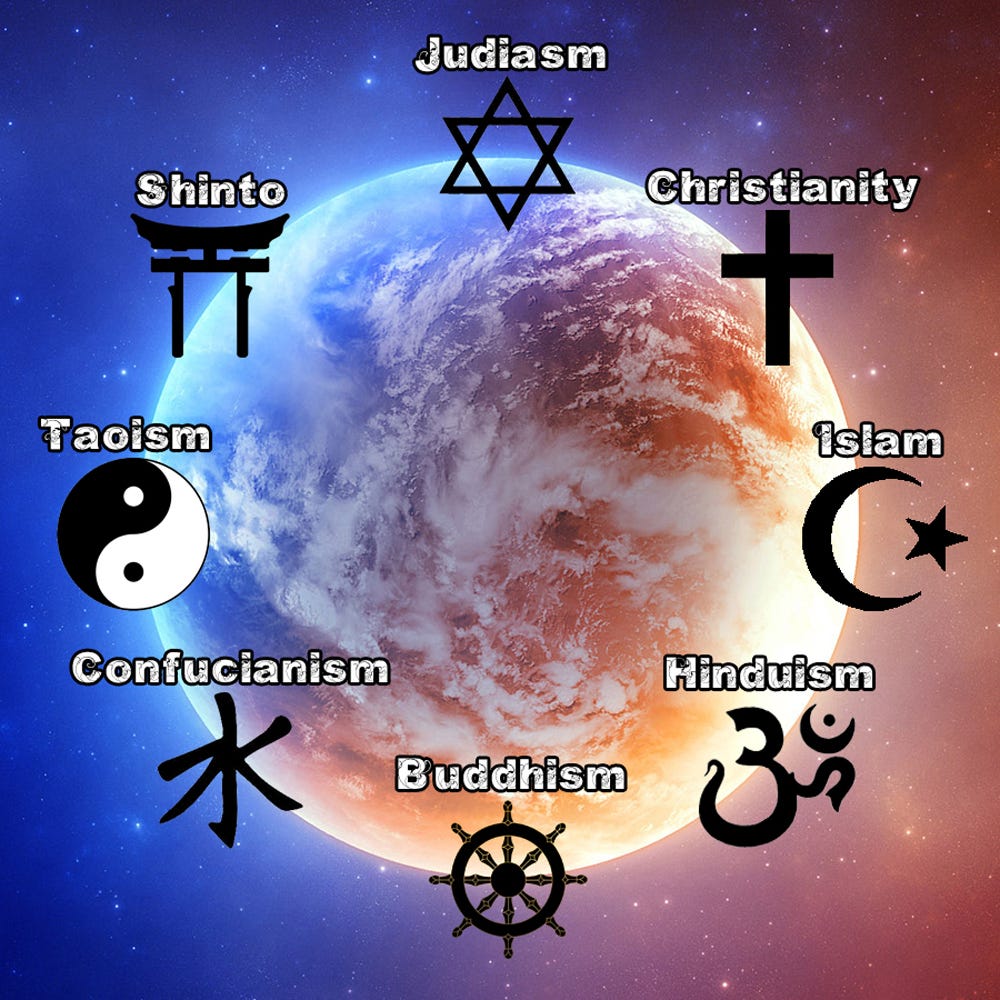
Why Are There So Many Religions If God is Real?
One of the most frequent criticisms of religion by atheists is the lack of agreement on various religions. They typically claim that if God existed then there wouldn’t be such a great divide in our views on Him. Unlike Science, where they claim there is universal agreement, there is no agreement on religion.
However, science is riddled with disagreement if we look at the issue of questions. For instance, various religions are asking different questions. Likewise, different branches of science are asking different questions as well. If one were to confuse the language used with the context of the question asked there would be a great deal of disagreement and confusion. For instance, if a biologist who is interested in addressing what the mechanisms of organisms are, they use language much different than say a physicist who is interested in the motion of things and identifying these trajectories, measurements, and so forth. And so, religion is no different than science with regards to answering questions. The different ‘religions’ emerge with the advent of what question is asked.
Let us unpack this claim. First, there aren’t ‘religions’ but only Religion. Religion is nothing more than the recognition, strategies, and attempts at ‘binding back’, changing the environment of, or addressing concerns on how to live and what to do to make the world ‘better’. So, with that settled, it is predicated on questions about how to do this. The secular humanist would see the religious obligation as merely addressing what brings about the most human flourishing. But then again this says nothing to what this human flourishing is and if this affects how we achieve it.
The theist is interested in exploring the question of the whoness of being, or to what extent there is a person or agency behind being. The muslim seeks to explore the whatness of this being God through seeing His transcendence and apophatic features. And indeed this is a legitimate and true question. To what extent can God be far removed from and separate, holy, from the imperfection of what He is. Likewise, Judaism seeks to explore the whatness of God in history. The Hebrew is interested in God IN history and His actions through His people that He has set aside to work with.
The Buddhist is interested in the how, how this god-ness is expressed in nature, reality, and the ultimate release of desire and longing. The Hindu in a similar manner is interested in the howness of God in Nature and observed reality and how this is reflected in the unobserved.
And every other ‘religion’ is some derivation of this (even the ancient pagan religions seek to understand the whatness of God or being in Nature). But there is one question that was never asked. One question that could never be objectified in a set of propositions, concepts, etc. Who is God? No one ever thought to ask and if they did they would see how ridiculous the question sounds. And yet, it is exactly the sort of question that needed answering. We cannot figure things out on our own. We have to be introduced to the person behind it, not merely told about Him. In the words of Robert Frost, we can never think things out, we have to see them acted out.
God had to demonstrated His transcendence through revealing Himself. God had to reveal Himself in history by being a part of history. God had to show us how to transcend want and desire, how to Nature and ourselves relate to one another. He had to do this by being a person. He had to come down and show us. The incarnation was just as inevitable as 2+2 coming before the answer 4. Only in Christ do we have the answer to the most important question, who is God, who is Love, who is the one that loves and sustains us.
And so, there aren’t many religions, but only ONE religion with many answers. And there is one question that is the most pressing for us, the most relevant and important, who is God? Jesus answered that NOT with a set of teachings but WITH His life and the story that He left in History.
What Affects Our Relationship With God: SinS or Sin?
I think far too often Christians are too quick to judge, identify and condemn SINS rather than SIN, and ultimately hurt Christ's Kingdom. In Matthew 7 where Christ talks about taking the mote out of one's own eye. It doesn't state that we CAN take it out though. The presupposing that the pastor here speaks of is assuming something that isn't necessarily given in the text. One would have to point to another passage that suggests one can take out one's own mote or that Christ takes out that mote in a moment. I don't see anywhere in scripture that suggests we achieve the level of holiness to perform this, save outside of Christ's substitutionary sacrifice for our sin. I would think that discernment is more appropriate a term than judgment, in that, one can point out 'ways' in life that do NOT lead generally to Christ. But we aren't in a position to state whether one's eternal destination is forfeit because of sin, only IF we do not accept that gift of God. We CAN state one should repent from sin, or the decision to follow Christ. But HOW that looks isn't so easy to say and we should extend more grace than pronouncement. If we catch someone smoking weed, we shouldn't tell them they are going to hell. Rather explain how that is NOT loving God or people and leave it at that.
Likewise the passage in verse 6 about discerning dogs and swine, this isn't suggesting that Christians distinguish between the saved and the unsaved. Rather, within the context of what Jesus is reflecting on and commanding back in chapter 6 concerning worry and prioritizing our lives. This would be an extension on that topic, namely, that we shouldn't treat things that are important to God as if they are the concerns of dogs and swine. We need to recognize the important things in life concerning His kingdom and not the kingdom of this world.
Also, when we look at verse 15 and Jesus' words about false teachers, this isn't suggesting that the PEOPLE PRESENTING false teachings are NOT FOLLOWERS of Christ necessarily. It just means that we should judge what is false TEACHING and what is TRUE teaching. For instance, when Peter is rebuked by Jesus for his criticism of God's plan to scourge Him for our sins, Jesus literally says get behind me Satan. And just a passage earlier Peter had RIGHTLY pointed out Jesus was the Christ. So Peter was presenting FALSE teaching even though he WAS a follower of Jesus. So, again, I would be VERY cautious in pronouncements about the eternal destination of a person or their hearts. Correct them YES. Deny that they are following after Christ? No.
Now when we read the passage many will say lord lord and not enter into His kingdom. This is also mirrored by the parable of the father with two sons and his vineyard. One says he will tend it and doesn't while the other says he will not and does it. These two passages are merely pointing out the principle of action over said-faith or empty words. If one is not only saying Lord Lord but speaking with people about Christ, are out in the streets loving others and sharing the good news of God, this to me suggests they are doing His will. Now I don't know if these hippies were doing this. But if they struggled with weed and LSD, even if they were struggling with the theological aspects of drugs, this doesn't mean that they aren't saved. Indeed, many followers of Christ had wrong views about circumstances in their life while doing great things for God, loving and caring for people, etc. David Wilkerson did as well concerning some wrong views he held concerning Christian rock and how that may have hurt people. But we don't say that he wasn't saved
Now I think that David Wilkerson was a great man of God and did GREAT things. But he was not perfect. Remember he was one of the biggest critics of Christian rock back in the day, which I think most people these days recognize as being on the wrong side of the discussion theologically. Does this mean he was a false prophet or teacher? No. It just means he was wrong on that issue. Likewise, these hippies were wrong on this issue but it shouldn't be an eternal pronouncement against them nor the fact of whether they were growing in Christ.
Subscribe to:
Posts (Atom)